
The Square Peg Problem: What Leadership Hides Behind Constant Motion
Two weeks ago, I had a total hip replacement. I’m still in recovery, moving slower than I’d like, with more time to think than usual. And in that stillness, I keep coming back to a lesson I earned the hard way. One I believe every leader needs to hear.
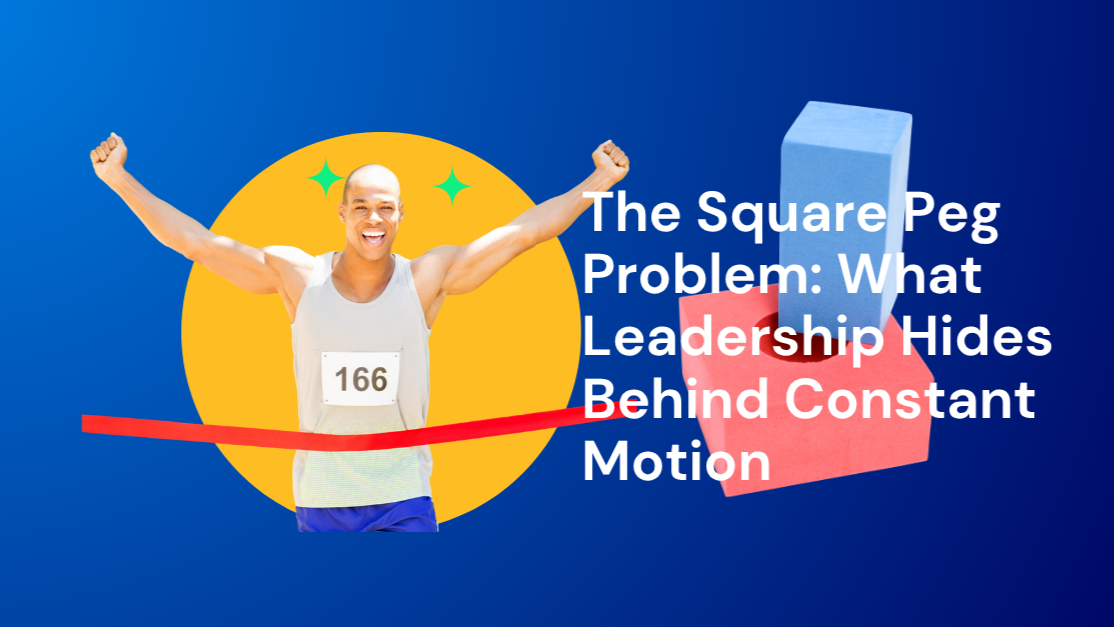
I trained for a marathon to get into shape — instead of getting into shape so I could run the marathon. I had the sequence backwards. And I paid for it with a total hip replacement.
Many organizations are running the same sequence right now. Meetings. Strategic plans. Initiatives. Crisis responses. All signs of movement. All evidence of running the marathon. But movement is not the same as being in shape.
I finished the marathon. People were impressed. But I knew what it had cost me — and I knew the difference between completing something and being successful. Twice before, I wore “I ran a marathon” proudly. This time, I wore it cautiously, because I knew what was behind it. That gap between external validation and internal truth is where hidden failure lives.
Ask yourself: where is your organization wearing its results cautiously? Where are the tasks completed but outcomes tell a different story?
THE DIAGNOSIS
“You’ve got a square peg trying to fit into a round hole. No amount of training or physical therapy is going to fix that. In fact, the more you keep going, the worse it’s going to get.”
Those were my surgeon’s words that hit so hard I adopted the phrase as a framework I now use in my leadership work. I call it the Leadership Square Peg – Round Hole Effect: continuing to force effort into a system that the evidence is telling you won’t fit, and getting worse results the harder you push.
I had lived it physically. My run times got slower. Each session hurt more. I never completed a run past 8 miles without walking. But I kept going, performing effort, treating motion as proof that things were fine.
Sound familiar? When people in your organization aren’t progressing, that is not just a performance issue. That is a system signal. The organizational equivalent of pain in the body.
What the Effect Looks Like in Organizations
• Proficiency is stagnant, but the planning calendar is full.
• Results are declining, but performance reviews are excellent.
• Teams are fatigued, but leadership keeps adding initiatives.
• Attrition is high, but promotions are given.
When my hip finally failed me, it wasn’t a surprise. I had been compensating, adjusting, pushing through — performing fitness instead of building it. I ignored the danger of leading myself as if everything was fine while the evidence said otherwise.
That is what the Leadership Square Peg – Round Hole Effect looks like in practice. It can be difficult to identify. It looks like busyness. It looks like commitment. It looks like motion. And it continues right up until the system can no longer compensate.
Accountability, Reframed
Accountability is not continuing to run the marathon. Accountability is asking: What do I need to strengthen so that this system can succeed, not just perform? Your strategic plan is the marathon. Your leadership — your decisions, your follow-through, your clarity — that is the conditioning. If you are not building the capacity required to meet the goal, then the goal becomes performance, not progress.
Outcomes are not separate from leadership. They are the evidence of how the system is functioning. It’s not about fault. It is about responsibility.
And responsibility begins with being willing to close the gap between what the results look like from the outside, and what you know to be true on the inside.
The question worth sitting with:
“Where are you leading as if things are in shape… when they are not?”
Dr. Rosenna Bakari is a leadership consultant / coach. Please reach out to explore what it looks like to support your leadership team through Seven Exits services.