
Stop Bringing God Into Your Mess
Some of the most damaging behavior I’ve witnessed arrived wrapped in religious certainty.
“God says.”
“God led me.”
“God removed them from my life.”
“God said wives should submit.”
“Spare the rod, spoil the child.”
“God knows my heart.”
Maybe some of that is true. But sometimes what we call conviction is simply bias laundered through holy language.
People sometimes use religion as a shield that protects them from examining their behavior, complacency, comfort, power, and the harm they cause. And once people believe their worldview is religiously sanctioned, reflection stops.
Claiming holy conviction is dangerous because certainty without reflection can make almost anything feel justified.
My Father’s Church
I felt the consequence of holy conviction growing up with my father. His reconciliation with my mother after missing the first 7 years of my life came with religious dogmitism blended with hypocrisy.
He insisted on our participation in religion. Then pulled our family from church to church whenever he had conflict with leadership. Every disagreement became evidence that the congregation lacked truth, lacked order, lacked proper authority.
Human beings have defended slavery, segregation, white supremacy, misogyny, violence against children, greed, and cruelty while believing themselves to be morally righteous.
What he was really searching for was a religious environment that would validate his misogyny and justify the way he treated my mother. He never found one that fully would. So eventually, he started his own.
That experience taught me early that people choose their behavior first, then find whatever ideology confirms it. I wouldn’t learn the term “confirmation bias” until years later as a psychologist. But I lived it in that house long before I could name it.
History has confirmed this bias repeatedly. Human beings have defended slavery, segregation, white supremacy, misogyny, violence against children, greed, and cruelty while believing themselves to be morally righteous.
Faith Requires More
However, religion never absolves anyone of personal accountability, and faith requires more than certainty.
No matter how loudly you defend your position or quote scripture to confirm what you already believe, it doesn’t make you righteous. Righteousness requires reflective capacity too. And that is much harder than certainty.
My father’s contradictions forced me into that kind of questioning early. A child relies on logic and predictability. When what he said about God was so disconnected from how he lived, I had no choice but to examine everything.
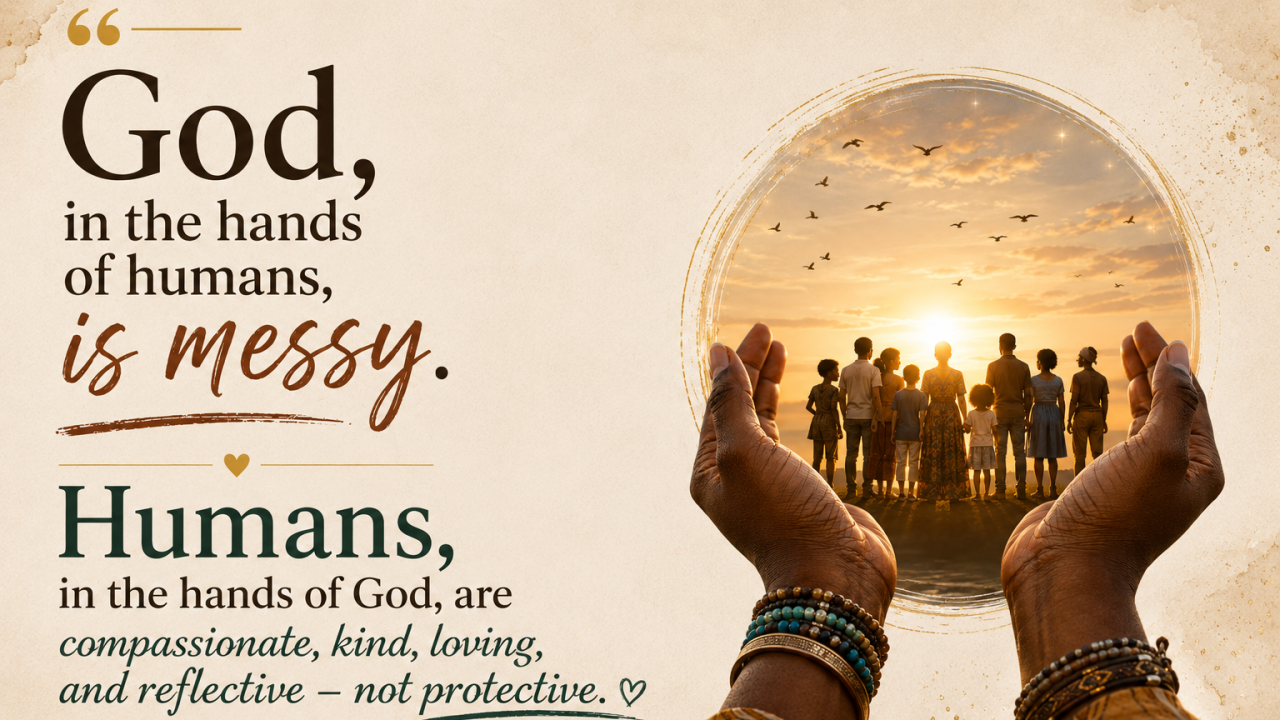
God, in the hands of humans, is messy. Humans, in the hands of God, are compassionate, kind, loving, and reflective — not protective.
At fourteen, my mother told me to seek God for yourself. With her permission, I did. I eventually read the Bible from cover to cover. I studied other holy books and traditions as well. What I found in all of them was the same at the core: love. They all command it. They all frame human beings as reflections of something sacred.
What I find in the world is that God has been appropriated to enforce hierarchy of the humans they choose to love. To determine who leads and who listens. To recruit soldiers of indoctrination rather than disciples of care and compassion.
God, in the hands of humans, is messy. Humans, in the hands of God, are compassionate, kind, loving, and reflective — not protective.
Questions Certainty Won’t Answer
Reflection asks questions that indoctrination and dogmatism don’t want to answer, such as these:
- How does this belief benefit me?
- Who loses power if it changes?
- Who gains dignity if it does?
- Does this belief deepen compassion, or protect my comfort?
- Am I becoming more humble, or more untouchable?
When religion is appropriated as doctrine and hierarchy, it asks very little of us. It asks only that we defend it.
When Silence Feels Holy
My heart has broken listening to women share that their mothers knew about sexual abuse perpetrated by their fathers and stayed silent under the weight of interpreted religious obligation. God hates divorce. A wife must submit. Keep the family together.
When belief becomes entangled with fear, shame, and survival for some, or power, control, and entitlement for others, it stops being examined. And because it is deemed holy, the harm stops being questioned too.
Social Media Post
Several months ago, I commented on a social media post featuring a man explaining to his young daughter why women should submit to men “as God intended.” I raised a few thoughtful questions instead of criticizing.
The post suggested that men were protectors as a strong argument for why women must submit. One of the questions I asked was what did women need protection from? And another was what protection are single women entitled to if that protection is so critical?
Research shows that the more loudly someone uses religion to establish their identity, the less likely they are to actually practice what it teaches.
What came back was hostility rather than reflection. I was called ignorant, bitter, permanently single, angry, and unable to keep a man by people who never paused to notice that I am a psychologist, have been married for 35 years, and that my work is rooted in positivity and care. These responses came from women and men alike, and also across races.
What struck me most was not the disagreement, but the contradiction. The same people defending Biblical order showed very little evidence of the humility, restraint, or emotional discipline they claimed scripture required.
Research shows that the more loudly someone uses religion to establish their identity, the less likely they are to actually practice what it teaches. Psychologist Gordon Allport first documented this in 1967 and the pattern has held up across decades of study since.
An Older Confusion
The cost of that gap between internal and external belief also shows up in how people raise children, how they treat the poor, and how they protect the rights of others.
Submission gets preached more passionately than self-awareness. Control gets confused with leadership. Silence gets mistaken for peace.
People even defend parenting with corporal punishment: The Bible says spare the rod. To question this practice would require many adults to grieve what they normalized long ago. So certainty steps in to protect them from having to.
The same pattern appears in how people talk about poverty. Suffering becomes evidence of spiritual failure. Poverty becomes proof that God has withdrawn favor.
What Faith Obligates
What happens when righteousness becomes a socially acceptable disguise for the refusal to examine ourselves? When conviction and ego become impossible to separate, protecting a worldview matters more than the people harmed by it.
Mature faith, however, should increase humility, compassion, curiosity, and awareness of our own capacity to cause harm.
A person genuinely grounded in faith should become more reflective over time, not less. More willing to repair, apologize, and reconsider.
Faith in its highest regard requires accountability to women, men, and God — not just God.
Accountability is remaining open enough to ask: What if my certainty is preventing me from seeing clearly?
Faithfully Accountability
Reflection is the highest form of faith. To genuinely believe something is to be willing to examine it. To hold it up to the light and trust that it can bear the weight of honest questioning. A faith that cannot survive scrutiny is not conviction. It is comfort.
You can quote scripture and still cause harm. You can feel divinely led and still be wrong. You can believe with your whole heart and still owe someone an apology. God’s name does not transfer your responsibility. It never did.
My father has long left this world. He gave me many things I had to unlearn. But somewhere beneath the contradictions, he left me with faith. Not religion. Faith. The kind that asks something of you.
A faith that cannot survive scrutiny is not conviction. It is comfort.
My mother, at 95, is still giving. The compassion she has poured into my life will outlast her years on this earth. I am certain of it.
What I know from both of them is that faith does not absolve us. It obligates us.
Dr. Rosenna Bakari is a personal and leadership empowerment partner. If this article resonates with you, feel free to connect. I'd love to hear from you.