
Babies and Bathwater
The Arc Is Familiar
The automobile was once considered a moral affront, reckless, unnatural, an insult to the pace of human life. Nobody remembers that outrage. We just drive.
What have you resisted in the past?
The microwave? You probably have one now. The cell phone? You likely cannot locate yourself without it.
I will admit I once advised all my single friends against online dating, reluctantly owning that confession alongside 35 years of marriage and a full catalog of dating advice that is apparently now obsolete. It works. People are finding real love through algorithms and profile pictures and opening lines typed into phones at midnight. My advice, earned and field-tested and deeply held, is out of sync. That is a significant thing to admit. But it is true.
The arc is familiar. We resist, we warn, we wait, and then we adopt. The technology moves and we move with it, because the alternative is standing still while the world reorganizes around us.
Now it is AI, and we are doing it again.
AI Makes It Accessible
We are treating a distribution worry like a theology problem. The debate splits into believers and resisters, each convinced the other is naive. We have not fully acknowledged that some of what AI is introducing has been here all along. AI just makes it more accessible.
For example, people have outsourced writing for years. Executives have had speechwriters. Brands have had content agencies. The people who could afford assistance with their words got it. Everyone else made do. AI performs that same labor and democratizes access to it.
I Am a Happy Consumer
I confess that I am a happy consumer on several levels. I never wanted to pay someone to plan a trip for me. The research, the logistics, the layered decisions about timing and transfers meant I would spend weeks, sometimes months, planning rather than pay someone. Now I use AI for all of it and am grateful for the time I save.
I also use AI for some of my images, even though research says audiences prefer human images. But what I observe on social media tells a different story. People respond to the quality of the content or the familiarity of the author. The skill level of AI far surpasses mine and more time is saved. Anytime someone or something is better, cheaper, and saves time, that is typically a win for me.
My favorite part about writing with AI is the collaboration. It does not write better than me. But I also do not write my best without it. I love when Claude or ChatGPT tell me the way I say it is better. I also like that it strengthens my writing by forcing me to correct all its bad habits.
As a solo entrepreneur who spends all my working hours alone, I am open to collaboration. I wrote my first book in 1996 and my dissertation in 2000, with five more books after that, long before this level of support was available. I know the difference between life with and without AI. I can handle either. I simply appreciate the support.
The Concerns Worth Taking Seriously
That said, I hold the ethical questions seriously, and classroom learning sits at the top of that list. I still teach online, and grading papers has lost its texture. I long for the days of correcting spelling and marking gaps in continuity in red. Reading twenty polished papers while knowing the lessons were never wrestled with is its own kind of defeat. The writing is clean. The thinking is absent.
We have a long way to go in recreating meaningful education. And yet resisting AI in education cannot be the solution, especially since we are not yet clear on what future we are educating our children for.
Not every concern deserves equal weight, though. Enhancing a headshot with AI or polishing a caption with a tool are not the same category of concern as classroom learning, yet some argue them with the same urgency. Conflating them muddies both.
The Detection Debate Has a Flaw
The detection debate carries an internal flaw. A barrage of articles insist that AI-written content is easy to spot, that the tells are obvious and the pattern is unmistakable. What these articles cannot account for is the evidence they will never see: the articles written with AI that were never flagged because there was nothing to flag. Good writing carefully shaped with AI as a collaborator reads like good writing.
There is a difference between writing by AI and writing with AI. The first is outsourced thinking. The second is a tool in the hands of someone who wants their writing to clearly reflect their thinking.
What We Are Really Talking About Is Accountability
We all have our reasons for where we stand with AI, whether we are trying to hold onto something or advance somewhere. AI is not a question of character in and of itself. It is not a moral question in and of itself. We deserve to fit AI into dialogues of morality and character, though. What we are talking about is accountability.
Accountability moves us forward with eyes open, asking who benefits, who is harmed, and what is at stake. For me, accountability means knowing what I wrote and what AI helped me shape. It means being able to sit in front of my audience and own every word. It means using the tool without losing myself as the author. My work today sounds very similar to my work from 1996. My voice has not changed.
AI-friendly or AI-Knowledgeable
There is a difference between being AI-friendly and being AI-knowledgeable. You get to determine what tools you will use as your needs change. When there is enough at stake for you to stake your claim, be open.
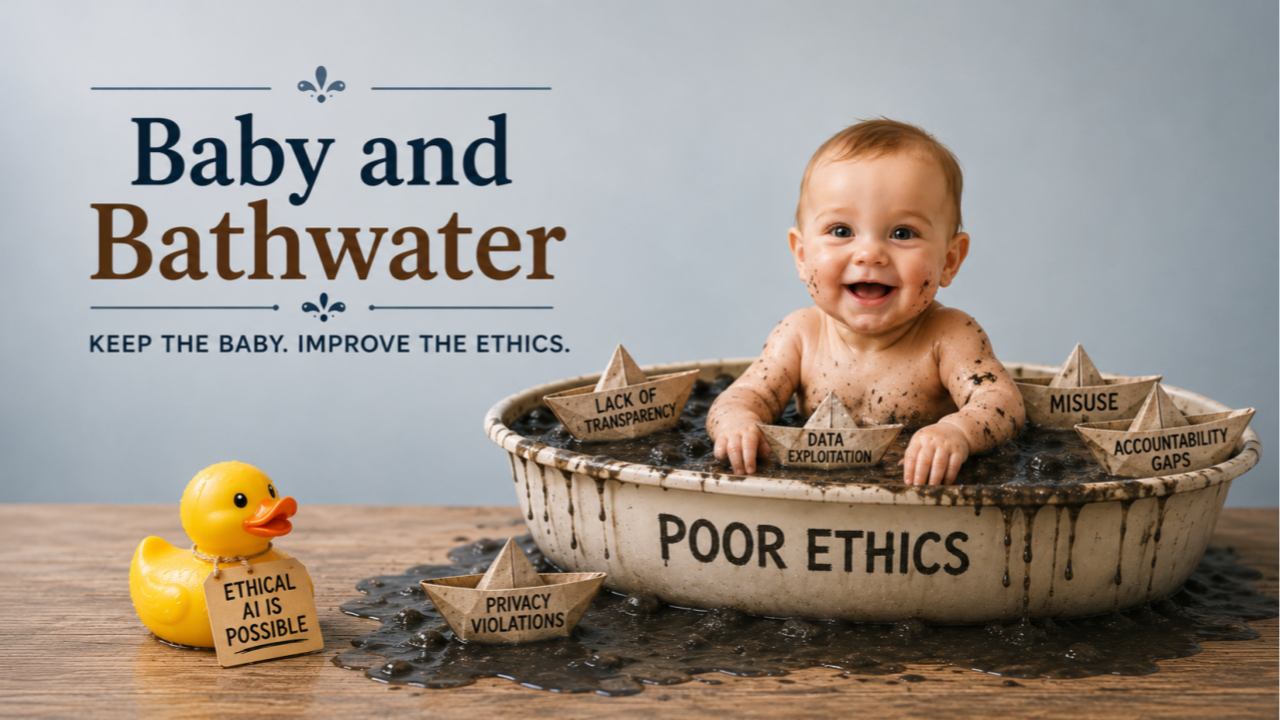
AI is already in the hands of your children, your clients, your competitors, and your communities. The question is how we hold each other accountable without throwing the baby out with the bathwater.
Every tool that reached the masses did so because some people refused to leave it exclusively in powerful hands. They picked it up, questioned it in use, and built norms around it slowly, imperfectly, and with consequence.
History has a pattern. The people who held out longest arrived late to tools that had already shaped the world without them, spending years catching up to people who had been building, creating, and connecting all along.
Resistance is real. Resistance also has a cost. Stay in the conversation. The improvement you seek may already be within reach.